
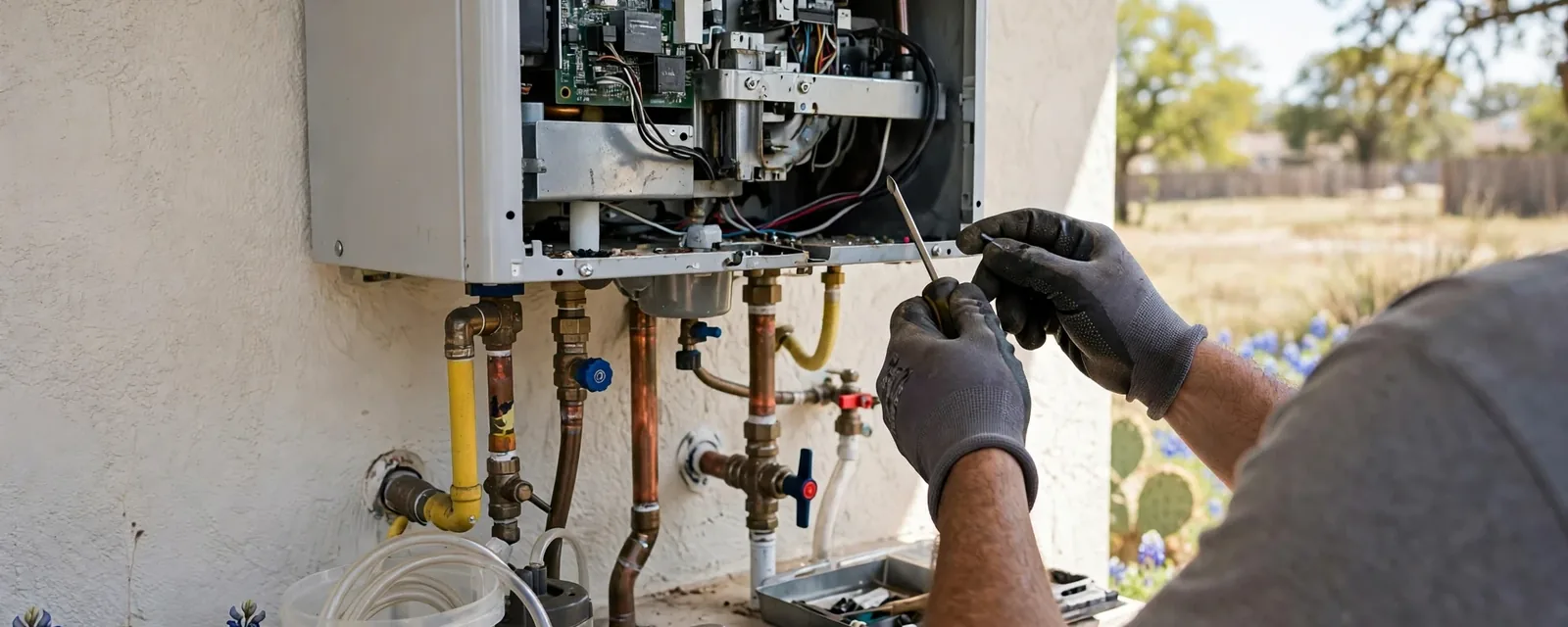
Lukewarm showers, a cold sandwich and a flashing error code
A tankless water heater service call in Shafter, CA starts with what you notice at the tap. A tankless heater warms water only while it flows, using a gas burner or electric elements and a heat exchanger. When something fails, the symptoms are usually the water temperature surging, going lukewarm or turning cold in the middle of a shower.
The cold sandwich is real. If you shut off a tap and reopen it soon after, the pipe holds cooled water and the heater needs a moment to relight. A very low flow can also fall below the minimum the unit needs to fire, which is why a trickling faucet may never get hot.
Reading the signs a tankless unit gives before it quits
Brands differ, so check the manual for the exact meaning of a code. These are common patterns.
- Water hot, then lukewarm. Scale narrows the heat exchanger, so the unit cannot reach the setpoint at full flow.
- Ignition or flame codes. A gas supply that is too small, a dirty flame rod or a failing igniter.
- Exhaust or vent codes. A blocked or leaking vent, or a condensate drain that has clogged.
- Flow codes. A clogged inlet screen, a worn flow sensor or a closed isolation valve.
- Temperature swings with one tap running. A mixing valve elsewhere or a crossover in a faucet cartridge.
Take a photo of the display before resetting the unit, because the code helps the plumber.
Tankless unit acting up? Call
Give the dispatcher the brand, the fuel and any code on the display.
Flushing and descaling a tankless heater with isolation valves
Many manufacturers call for periodic flushing, so check your manual for the interval. Hard water makes scale form faster.
- Confirm the isolation valvesA unit set up for service has two valves with service ports on the hot and cold lines. If yours has none, the plumber adds them first.
- Power down and close the valvesTurn off the unit and close both isolation valves, and shut the gas valve on a gas model.
- Connect hosesOne hose runs from the cold service port to a pump and a bucket, and the other returns to the hot port, forming a loop.
- Circulate the descalerA pump drives white vinegar or a manufacturer approved solution through the exchanger, commonly for about an hour. Vinegar without a pump is weaker and can leave scale behind.
- Rinse and clean the screenFlush with clean water, open the cold inlet filter and brush it, then reopen the valves and bring the unit back up.
Why minerals build up and what to do about the source
Heated water drops dissolved minerals, and in a tankless unit they stick to the narrow passages of the heat exchanger. The faster the water heats, the more it sheds. We cannot give you a hardness figure for Shafter, so test your tap with a kit or send a sample to a lab.
You can also ask the City of Shafter utilities for its annual water quality report. If testing shows high hardness, a softener or filter upstream of the heater may lower the flushing frequency, and our water softener and filtration page explains how that decision works.
What a tankless unit asks of your house before it goes in
A gas tankless heater burns a lot of fuel in a short burst, so the existing gas line may need upgrading. We do not state a pipe size here because it depends on the unit, the run and the other appliances. The plumber measures the load and the line and tells you if a bigger line is needed.
Venting is the second big item. Most gas units use plastic or stainless pipe through a wall or roof, and they need a condensate drain if they are high efficiency. Electric tankless units need a high amperage circuit, and a new circuit is electrician work, which we do not do. For the planned side, see water heater installation.
Garage installs face dust and summer heat, with July highs near 99 F in Shafter, so keep the intake and vent clear.
Tankless versus tank, and fixing versus replacing a tankless unit
Two decisions come up. Whether to own a tankless at all, and whether to repair one that has trouble.
| Question | Lean toward | Why |
|---|---|---|
| Large household with back to back showers | Tankless, sized to the flow | Heating on demand does not run out, as long as the flow stays under the unit's limit. |
| Tight budget and a working tank | Keep the tank | A conversion adds gas, vent and sometimes electric work. |
| Scale, a dirty screen or a failed igniter | Repair | These are service items on a sound heat exchanger. |
| Cracked or leaking heat exchanger | Replace | The core part costs close to a new unit. |
| Repeated faults on an older unit | Discuss replacement | Parts support can end for old models. |
When a tankless repair beats a new unit
Most tankless failures are small. A flow sensor, an igniter, a fan or a pressure switch can be changed in a visit if the part is available, and a good flush fixes many temperature complaints. A heat exchanger that has frozen or cracked is the one that tips the balance toward a new unit.
If a tankless unit has stopped working in the middle of the night, a hot-water outage is a water heater repair call, and the dispatcher takes those 24/7. We also take tankless calls from Wasco, roughly 10 miles up State Route 43.
What affects the cost of tankless service
We give a clear price by phone and on site before work starts.
- Service type. A flush is smaller than a part swap, and a new install is larger than either.
- Access to valves. A unit with isolation valves is quicker than one that needs them added.
- Unit brand and parts. Some parts are common, and others take time to source.
- Gas and vent work. A bigger gas line or a new vent run adds labor.
- Scale level. A heavily scaled exchanger may need a longer cycle or a second pass.
Standard homeowner insurance usually covers sudden damage and not wear or scale, so check your policy. Call the dispatcher for the real number on your unit.
Tankless water heater questions from Shafter homeowners
How often should I flush a tankless water heater?
Many manufacturers call for periodic flushing, so check your manual for the interval. Water with more minerals shortens it.
A water test tells you how aggressive your tap is.
Can I flush it myself with vinegar?
It is possible if the unit has isolation valves with ports. You need a small pump, two hoses and a bucket, and gas units need the gas shut off.
Without valves, call a plumber. Forcing fittings can leak.
Why does my tankless heater show an error code?
The code names a sensor or a part that read out of range. Common ones are flame, exhaust, flow and temperature faults.
Write down the code and the brand before calling.
Is my gas line big enough for a tankless unit?
A tankless heater draws more gas than a tank, so a gas line may need upgrading. The plumber measures the load and tells you.
We do not guess a size over the phone.
Why does the water go cold for a few seconds?
That is the cold sandwich, caused by cooled water in the pipe or by a low flow that drops under the unit's minimum.
A recirculation setup can reduce it.
What affects the cost of tankless water heater service?
The type of service, access to valves, the brand, any gas or vent work and the scale level all matter.
Call for a clear price before we start.
Questions about your tankless unit? Call (855) 575-2890 and the dispatcher will point you to the right visit.