
Gurgling, slow everywhere, or sewage in the tub
Sewer line cleaning in Shafter, CA clears the main drain that carries every fixture's waste out of the house toward the sewer connection. When that pipe clogs, symptoms show up in several places at once, and our dispatcher treats it as urgent on a 24/7 line.
Hold off on laundry, showers and dishwasher cycles, because every gallon now has nowhere to go but the lowest opening. Keep the cleanout cap closed and stay out of a flooded bathroom floor. Flush nothing, even if the toilet looks empty. Call (855) 575-2890 and say which fixture backed up first.
Same-day visits are possible when equipment and crews are free. Overnight and weekend backups go to the same dispatcher.
What the lowest drain is telling you
The order in which fixtures fail points to where the blockage sits.
Toilet gurgles when the washer drains
Air is pushed back through the water seal because the main line is slow. The washer discharge is often the first load to show it.
Tub or floor drain backs up when you flush
The tub drain or a basement floor drain is often the lowest point in the house, so waste rises there first. That points at the main line, not the tub.
Only one fixture is slow
That is a branch line problem and a smaller machine solves it. A main line visit would be more than the job needs.
A sewer smell with sluggish drains
A partial blockage or a dry trap can let odor into the house. If the smell is more like gas, leave the house and call your gas provider from outside.
Finding the cleanout cap before the plumber does
A cleanout is a capped pipe, usually 3 or 4 inches across, that gives direct access to the main line. Look along the outside of the house near the bathrooms or kitchen, close to the foundation, or near the property line where the line leaves the lot. Some sit in a garage wall, a crawlspace or a box in the ground.
Take a photo and note where it is, but do not unscrew the cap during an active backup unless the dispatcher asks. Sewage can sit above the cap, and opening it releases that water onto the ground or the floor. Caps also seize with age, and a plumber brings the right wrench and a plan for the spill.
A house with no cleanout needs another entry point. The plumber may pull a toilet or work through a roof vent, and we may suggest installing a cleanout so the next visit is cleaner.
Sewage backing up? Call the 24/7 line
Tell the dispatcher which fixture failed first and the plumber plans the machine to bring.
The machine, the cable and the cutter heads
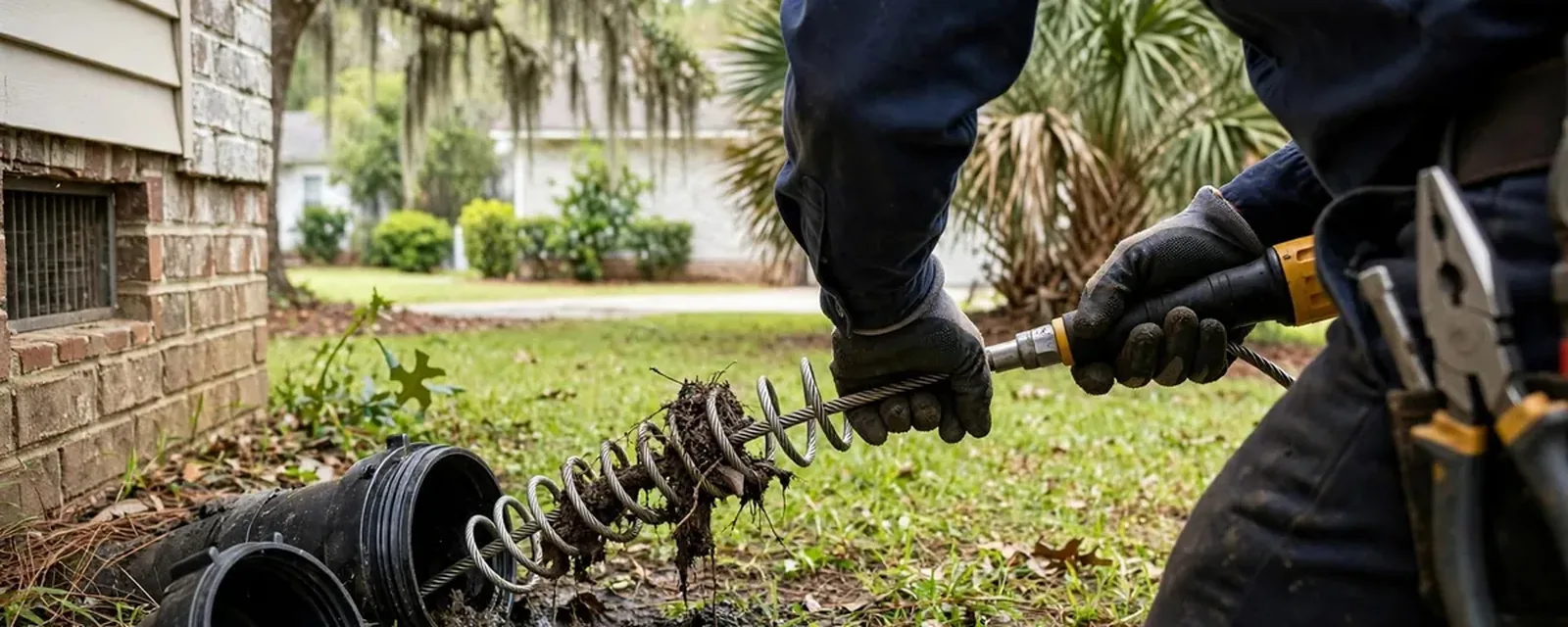
A main line machine is a drum of heavy cable driven by a motor, far larger than the hand snake under a sink. The cable goes through the cleanout and out toward the street, and the plumber feels the load through the cable as the head meets the stoppage.
Heads for different blockages
A spade or arrowhead punches through paper and grease. A spiral head grabs rags and hair, and a retrieving head hooks objects. For roots, a cutter head with chains or blades shaves them off the pipe wall as it spins.
Why a camera follows the cable
A pipe can drain well after cabling and still hold roots or a belly. A push camera confirms the line is open and shows the wall, and the sewer camera inspection page explains what the recording shows.
Sewer line cleaning versus drain cleaning
Both clear stoppages, but they work on different parts of the plumbing.
| Point of comparison | Fixture or branch drain | Main sewer line |
|---|---|---|
| Where the blockage sits | Within a few feet of one sink, tub or toilet | Past the branch lines, between the house and the street connection |
| Typical symptom | One fixture slow or full | Several fixtures slow, gurgling, or the lowest drain backing up |
| Access point | Trap, pop-up or fixture drain | Main cleanout or a pulled toilet |
| Equipment | Hand or small drum cable | Main line machine, cutter heads, sometimes a jet |
| Follow-up | Run water at the fixture to test | Camera pass to check the pipe |
If you are unsure which one you have, the drain cleaning page covers single-fixture problems. If three fixtures complain at once, assume the main line.
Roots and an honest cleaning schedule
Roots enter a sewer line at joints and cracks, drawn to the water and nutrients inside. A cutter clears them for now but does not seal the opening. Roots return at a pace set by the tree, the soil moisture and the size of the gap.
We do not hand out a fixed interval. A line cleared after a first root event may stay clear for a long stretch or clog again in months, and the camera after cutting helps tell which. If it comes back quickly, scheduled cleaning is a stopgap and a repair is the real fix.
Hydro jetting is an option after cutting, since high-pressure water washes out the shredded root and leaves a cleaner wall than a cable alone. It needs a camera look first so the water does not hit a broken section.
When cleaning will not be enough
Cabling and jetting clear stoppages. They do not fix pipe. A line that clogs again within weeks, a cable that hits a hard stop at the same spot, or a camera that shows a gap, an offset joint or a belly points to repair. The sewer line repair page covers spot repair, lining and replacement and their trade-offs.
Ask where the problem sits before paying for a second cleaning. If every house on your street is backing up at once, also call City of Shafter Utility Services, because the blockage may be in the city main. The City of Shafter provides sewer service, and a private lateral on your lot is a different case.
We take main line calls from McFarland too, roughly 15 miles from Shafter. Tell the dispatcher your street and which side of Highway 99 you are on.
What shapes the bill for a main line clearing
You hear a clear price before work starts. These factors drive it.
- Cleanout access. A cap that unscrews is quick. Pulling a toilet or cutting in a cleanout adds labor.
- Length and depth. A short run to the street is a smaller job than a long lateral.
- Type of blockage. Paper and grease clear faster than a dense root mass.
- Equipment. A cable, cutter heads, a jet and a camera each add equipment and time.
- Hour of the call. Overnight and weekend visits are priced differently than a planned weekday visit.
- Follow-up camera. A second look costs time but shows whether the line is truly open.
Standard homeowner insurance usually covers sudden damage and not wear or roots, so check your policy. Call the dispatcher for the real number on your main line.
Main line cleaning, answered
Do you handle sewer line cleaning emergencies at night or on weekends in Shafter?
Yes. The dispatch line runs 24/7, including overnight and weekends, and same-day appointments are available when the schedule allows.
A backup into a tub or floor drain is treated as urgent. Stop using water and tell the dispatcher what you see.
Should I open the cleanout cap myself?
Not during a backup, unless the dispatcher tells you to. Sewage may sit above the cap and spill when it is opened.
Do locate it and take a photo. That saves the plumber time on arrival.
How is sewer line cleaning different from drain cleaning?
Drain cleaning works on one fixture or branch with a small cable. Sewer line cleaning works on the main line with a larger machine, cutter heads and sometimes a jet.
If more than one fixture is slow, it is likely the main line.
How often should a main line be cleaned?
There is no set schedule. A healthy line may need none, while a root-prone line may need cleaning each year or more.
A camera pass after cleaning shows how fast trouble is likely to return.
Will cleaning stop roots for good?
No. A cutter removes roots but leaves the opening they entered through. They can return until the joint or pipe is repaired or lined.
That is the point at which sewer line repair is worth discussing.
What affects the cost of sewer line cleaning?
Cleanout access, line length, the type of blockage, the equipment needed and the hour of the call all matter.
Call for the clear price before work starts. A follow-up camera adds time but shows the result.
Main line questions? Call (855) 575-2890 and the dispatcher will help you work out the next step.