
What a leaking sewer line does underground
A sewer line leak is a crack, a separated joint or a hole in the pipe that carries wastewater from your house to the city main or a septic tank. In Shafter, CA the leak is rarely dramatic. Wastewater seeps into the soil around the pipe, and the damage builds for months before anything shows on the surface.
Most leaks start at a few weak points. Tree roots push into a joint looking for moisture. A section of pipe settles and forms a belly. An old coupling pulls apart, or a past repair was never sealed well. Once a gap opens, soil can wash into the pipe and slow the flow, which is why a leak and a partial clog often arrive together.
The wastewater that escapes is not harmless. It carries bacteria, it softens the soil under a driveway or slab, and it feeds roots that make the gap wider. That is the main reason to chase a suspected leak early instead of waiting for a backup.
Clues in the house and the yard
No single clue proves a leak. Two or three together are a good reason to get the line tested.
- A sewer smell outdoors. A faint rotten-egg odor near the cleanout, along the side of the house or over the lateral points to escaping gas or liquid.
- A green, soggy or sunken patch. Grass that stays lush through a dry July, when daytime highs sit near 99 F, is being fed from below. A small dip in the soil can mean the ground has washed into the pipe.
- Gurgling and slow drains. If the toilet bubbles when the washer drains, air and water are fighting through a restricted or damaged section.
- Repeat clogs after cleaning. A line that clears and clogs again within weeks often has roots or a belly at the same spot.
- Pests and damp slab edges. Rodents, drain flies and a musty smell along an exterior wall can follow a leak that wets the soil near the foundation.
- Cracks or heaving in flatwork. A driveway or walkway that settles above the line path can mean the soil underneath is washing away.
Keep notes on when each sign shows up. A pattern after laundry or heavy rain, which in Shafter falls mostly between November and March, helps the plumber narrow the search.
Simple checks to run before anyone digs
These steps cost nothing and rule out easier causes. They do not replace a camera, because the pipe is buried and you cannot see inside it.
- Find the cleanoutLook for a capped pipe, usually three or four inches across, near the foundation or at the property line. Do not open it if wastewater is already near the top.
- Run every fixture one at a timeFlush each toilet and run each sink, then note which ones gurgle or drain slowly. A problem at one fixture points to its own branch, while all of them point to the main line.
- Watch the lawn after laundryRun a full washer load and check the suspect patch and the cleanout area for new dampness or odor within the hour.
- Check the water meterIf the meter spins with every fixture off, the leak may be on the supply side instead. That is a different repair, and a leak detection visit can sort it out.
- Write down what you findPhotos of wet spots, the date of the last cleaning, and the fixtures involved give the plumber a head start.
Want the line checked, not guessed at?
Call the line and our dispatcher will set up a licensed plumber with a sewer camera.
Dye, camera, smoke and water-fill tests compared
Four methods confirm a sewer leak. Each answers a slightly different question, and a plumber often combines two of them.
| Test | What it shows | Limits |
|---|---|---|
| Dye test | Colored water flushed through a fixture shows whether wastewater is reaching the soil, a drain or a nearby ditch | Confirms a leak exists but not exactly where |
| Sewer camera | A live video of the inside of the pipe, with the depth and distance of cracks, roots and bellies | Needs a clear path, so a heavy clog may need cleaning first |
| Smoke test | Harmless smoke blown into the line rises where a vent, joint or crack is open to the air | Works best on dry soil and gives no view of pipe condition |
| Water-fill test | The line is plugged and filled, then watched to see if the level drops over time | Shows a loss of water but not the location of the break |
A camera pass is the usual starting point because it shows the break itself. The recording also helps if you need to compare repair options later.
What the camera footage tells you
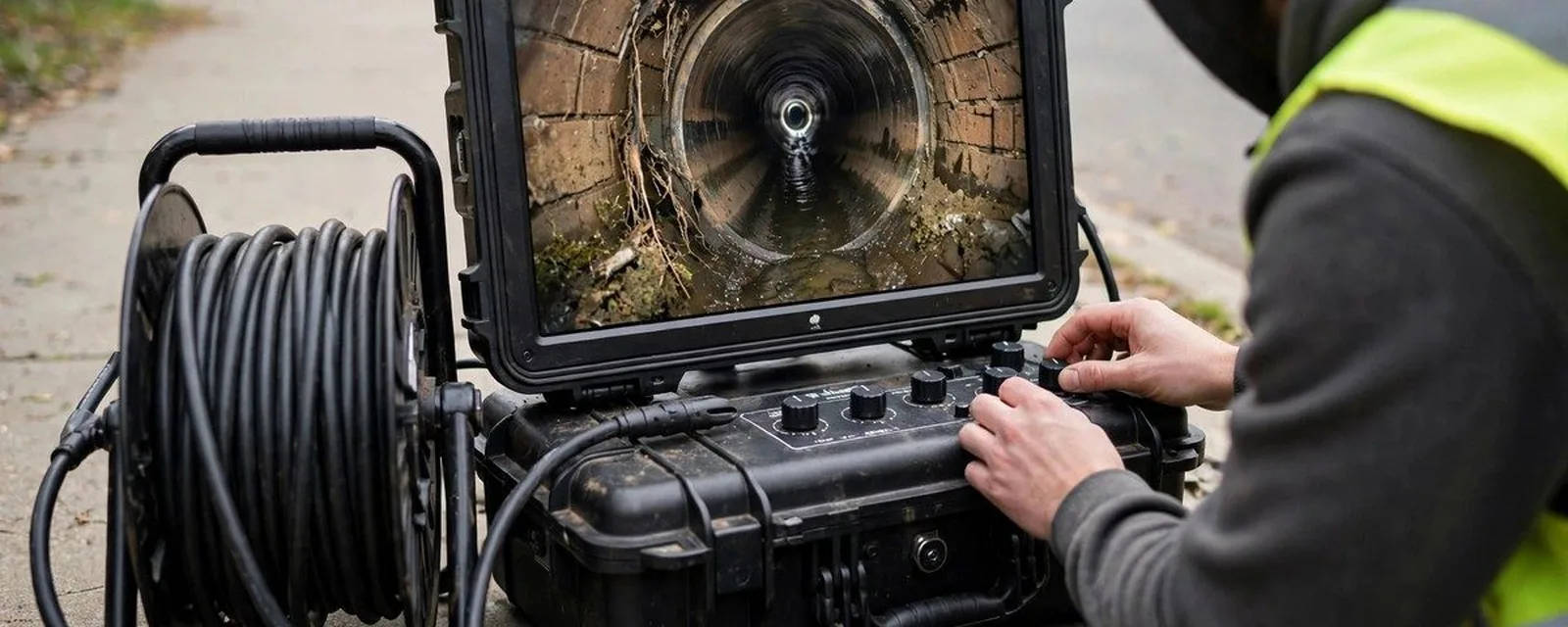
A sewer camera is a small lens on a flexible cable, pushed in through the cleanout. The plumber watches a monitor and a locator that tracks the camera head from above ground. That locator gives the depth and the spot to mark on the lawn, so a repair can be planned around it.
Footage usually falls into a few patterns. Roots appear as hairy white masses at joints. A separated joint looks like a gap with soil visible behind it. A belly shows as standing water in a section that should drain freely, and a crack appears as a dark line along the pipe wall.
Our sewer camera inspection covers the whole run from cleanout to the main or tank, and the recording stays with you. Ask the plumber to pause on each defect and say how far from the cleanout it sits.
Repair choices once the break is located
The right fix depends on the type and size of the defect, not on a single method. A short spot repair suits one cracked section. Lining or pipe bursting can replace long runs with less digging, and a full excavation makes sense when the pipe has collapsed or is badly out of line.
Each approach has trade-offs. Lining needs a mostly open pipe, and heavy bellies can limit it. Excavation is the most disruptive to a yard but gives full access. A plumber should explain why a method fits your footage before work starts, and the price should be clear before any digging begins.
If the camera shows a defect, our sewer line repair crew can walk through the options on the recording. We do not guess at a fix from the surface.
When a leak becomes an urgent call
Wastewater coming up through a floor drain, a toilet that will not stop backing up, or sewage pooling in the yard needs a plumber right away. Stop using water in the house, keep children and pets away, and avoid touching the standing water. Strong sewer gas smell indoors is another reason to call at once.
Sewer or septic in Shafter
The City of Shafter provides sewer service to residential and commercial customers through City of Shafter Utility Services, so most homes in town connect to a city main. Ask the utility where the city's responsibility ends and yours begins, because a leak on the private lateral is the owner's to fix. That answer tells you who to call first.
Some properties outside the city, including rural lots near North Shafter or Smith Corner, may use an onsite septic system instead. Kern County Environmental Health runs the onsite wastewater treatment program. Contact Kern County Environmental Health if you are not sure which system serves your property.
Source type: City of Shafter Utility Services page and Kern County Environmental Health program page
Neighbors in Wasco and McFarland
Homes farther out follow the same pattern. If you live in Wasco, our Wasco emergency plumbing page explains how dispatch works for your area. McFarland homeowners can read the McFarland service area page for the same details.
Whichever town you are in, ask your own utility who maintains the lateral and the main. Call (855) 575-2890 if you want a licensed plumber to run a camera and put the findings in writing.
Questions about sewer leaks
Can a sewer line leak without any backup in Shafter, CA?
Yes. A slow leak can run for months while drains still work, so the first signs are often a smell, a green patch or a soft spot in the yard. Check your cleanout and drains when you see these, and ask the City of Shafter Utility Services where the city line ends and yours starts.
Is a dye test enough to find the leak?
A dye test confirms that wastewater is escaping, but it does not say where. You still need a camera and locator to mark the spot. Many plumbers use dye first for a quick yes or no and then run the camera.
Does a smoke test hurt anything inside the house?
No. The smoke is a nontoxic fog used by utilities and plumbers, and it rises through gaps. Tell everyone beforehand so no one mistakes it for a fire, and make sure P-traps hold water so smoke does not enter the home.
Will homeowner insurance cover a leaking sewer line?
Policies differ a great deal. Many cover sudden damage but not wear, roots or age, so read your policy and ask your agent. Keep the camera recording and your notes, since they support a claim if one applies.
How do I know if my home is on city sewer or septic?
Look at your utility bill for a sewer charge, or ask City of Shafter Utility Services. If there is a buried tank and drain field, contact Kern County Environmental Health. A plumber can also trace the line with a camera.
If your drains or yard show these signs, our dispatcher can arrange a camera visit, so just Call (855) 575-2890.