
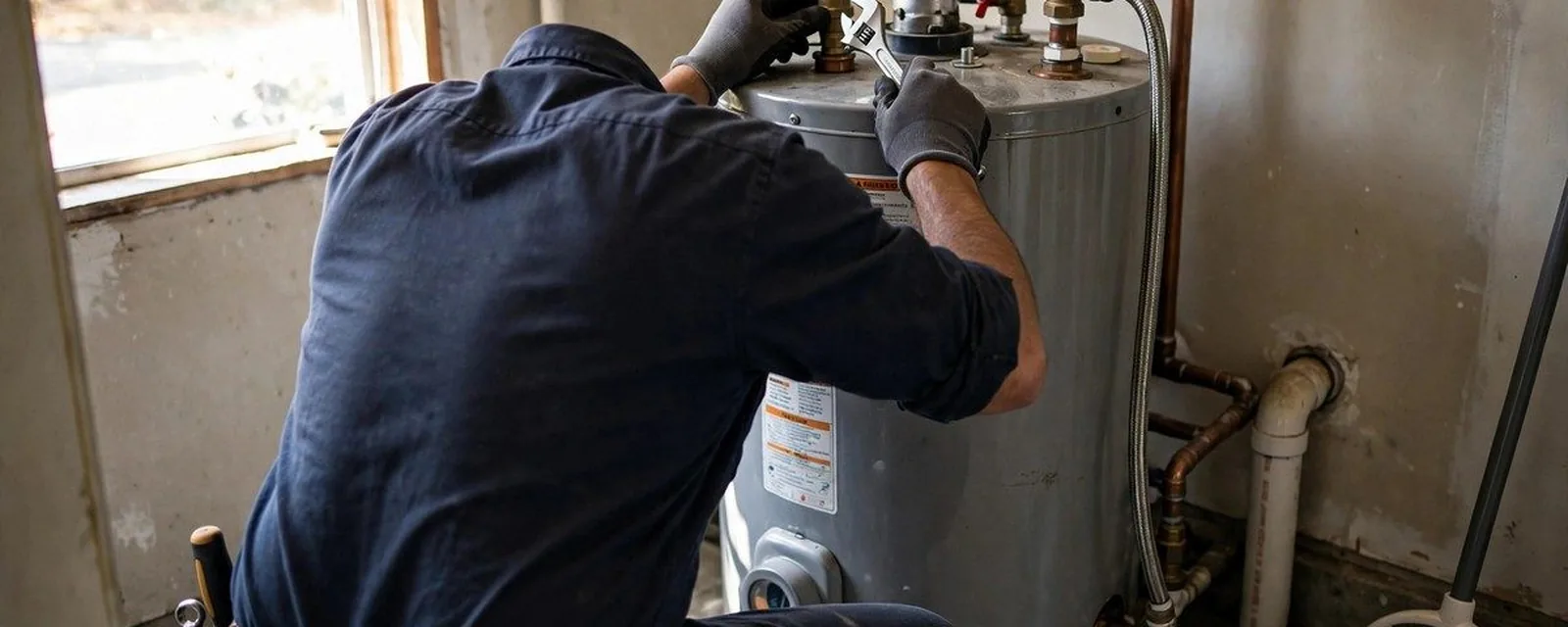
Why this choice is easier than it feels
Most repair or replace dilemmas come down to three facts. How old is the tank, where is the problem, and how much of the heater would a repair actually renew. In Shafter, CA those facts can be gathered in ten minutes with a flashlight and a phone camera.
The wrong answer costs you in both directions. Pouring money into a worn tank buys a few months and then a second bill. Replacing a heater that only needed a thermostat or an element throws away years of service.
The sections below give you a framework in the order a plumber would use it. Start with the label, because it decides how hard the other checks should be judged.
Reading the label before you call anyone
The data plate on the side of the tank holds the clues. Take a clear photo of it.
- Find the serial numberLook for a line of letters and digits near the model number. Many makers encode the month and year in the first few characters.
- Decode the dateSome brands use a letter for the month and two digits for the year. Others print the date outright. Ask the manufacturer's support line how to read your serial.
- Note the capacity and fuelGallons, gas or electric, and the vent type tell a plumber which parts to quote.
- Check the warranty stickerSome labels list a coverage period. Parts under warranty change the math for a repair.
- Write down what the tank is doingCold water, lukewarm water, noise, a pilot that will not stay lit or a wet floor each point in a different direction.
What the tank's age really tells you
Age is a guide, not a verdict. A storage tank is a steel vessel with a glass coating, and the coating slowly fails. Many tanks run for ten years or more, and some stop sooner when water chemistry or heat is hard on them.
A heater in its second decade has little margin left. A repair on a tank that old can feel like patching a tire that has been patched twice. A heater in its first few years usually deserves a proper repair, especially if a warranty still applies.
Tankless units follow a different logic. They are built to be rebuilt, and a burner, a flow sensor or a heat exchanger can often be serviced. A neglected unit with scale buildup may need only a flush.
Want a verdict on your own heater?
Call the line and our dispatcher will send a licensed plumber to look it over.
Where the problem sits and what it usually means
Location matters more than almost anything else. Use the table as a first pass, then have the tank inspected.
| What you see | Likely cause | Usual direction |
|---|---|---|
| Water at the bottom seam or under the tank | The inner tank has corroded through | Replace, since a tank leak cannot be patched |
| Drip from the TPR valve or its pipe | Pressure or temperature is too high, or the valve is worn | Repair, then check the expansion tank and thermostat |
| Leak at the inlet or outlet fittings | A loose or corroded connection | Repair if the tank body is dry |
| No hot water on an electric unit | A failed element, thermostat or tripped limit switch | Repair |
| Pilot will not stay lit on a gas unit | A weak thermocouple or a draft problem | Repair, after checking the vent |
| Rumbling or popping | Sediment hardened at the bottom of the tank | Flush, or replace if the tank is old |
| Rusty hot water only | Corrosion inside an aging tank | Likely replace after an anode and tank check |
If the water at the base of the tank is coming from the tank itself, no part swap will stop it. That case is the clearest replace verdict in this guide.
Parts that are worth fixing
Some failures are cheap fixes on an otherwise healthy heater. An electric element or thermostat fails on its own schedule, and replacing one restores heat. A gas thermocouple, igniter or control valve is also a bounded repair.
A TPR valve that drips deserves attention, because it is a safety device. It can mean the valve is worn, or that pressure in the system has risen, or that the thermostat is set too high. A plumber will test the valve and the supply pressure before swapping anything.
A flush of sediment can also bring a tired tank back, if the tank is not corroded. Our water heater repair service handles these jobs, along with checks of the vent and gas connection.
The repair versus replace logic in plain terms
Ask what the repair renews. A new element renews an element. It does not renew the glass lining, the anode rod or the welds. If the tank has years of wear in it, a repair buys the length of life that is left, not a fresh start.
A rough rule that plumbers use is to compare the repair against the replacement and the remaining age. A modest repair on a young tank is easy to justify. A large repair on an old tank rarely is. Ask for both numbers in writing, with a clear price before work starts.
Also weigh the risk. An old tank that fails fully floods a closet or garage, and that cost can outrun the savings from patching it.
What a plumber checks during the inspection
A proper look takes less time than most people expect. These are the usual stops.
- The base and the drain valve. Moisture, rust flakes or mineral crust here suggest the tank is failing from the inside.
- The anode rod. A rod eaten down to the steel core means the tank has lost its protection.
- Supply pressure and the expansion tank. High static pressure beats up fittings and makes the TPR valve weep.
- The vent, flue and combustion air on gas units. A weak draft can mimic a bad pilot assembly.
- The thermostat settings and element readings on electric units. A meter test shows which element has died.
- The age and the warranty status. These frame every price comparison that follows.
With those findings, the plumber can lay out a repair path and a replacement path side by side. You then choose with real information in hand.
Garage, closet and attic conditions in Shafter
Heat shortens the life of rubber seals, wiring insulation and valves. Shafter's July daily high averages about 99 F, so an attic or a closed garage can bake a heater through the long summer. A tank in that kind of space ages faster than the label alone suggests.
Check the area around the heater for stains, rust streaks on the pan and brittle flex connectors. A bone dry pan is a good sign. A damp pan and a rusty base are not.
Safety checks that come before any decision
If you smell gas, leave the building and call SoCalGas from outside if SoCalGas is your provider. Call 911 if the leak could endanger anyone. Do not look for the source or flip switches.
If water is pooling, shut the cold supply valve above the heater and turn off the breaker or the gas control. Keep children and pets away from hot surfaces.
Finding the manufacture date on a Shafter heater
Heaters in Shafter, CA carry the same kind of label as anywhere else. It sits on the side of the tank, often behind insulation or an access panel. Take a photo before you call, and have the model and serial handy.
Because each maker encodes dates differently, we do not guess. Ask the manufacturer's support line how to decode your serial. The answer sets the age for the decision.
Source type: manufacturer data plates and manufacturer support lines
When the verdict is replace
A body leak, a rust colored hot water supply, repeated failures in one season and an age past ten years all point toward a new tank. A repair on top of those signs is rarely sound.
Our water heater replacement team can swap a like for like tank when equipment is available, and the same visit can check the venting, the pan and the expansion tank. The swap also resets the clock on the anode and the warranty.
Our dispatcher also takes calls from Wasco, roughly 10 miles from Shafter, and McFarland, roughly 15 miles away. For a second opinion on your own heater, Call (855) 575-2890 and describe what you see.
Questions Shafter homeowners ask before deciding
Is a ten year old water heater worth repairing in Shafter, CA?
It depends on the problem. A bad element or thermostat on a dry, clean tank is worth fixing. A leak from the tank body is not. Summer heat in Shafter can age a heater in an attic or garage faster, so inspect the base and the pan.
Can a leaking water heater be fixed?
If the leak comes from a fitting, a valve or the drain, often yes. If water comes from the tank itself, the inner shell has failed and replacement is the answer.
How do I find how old my water heater is?
Read the serial number on the data plate. Many makers encode the month and year. Call the manufacturer's support line to confirm how to decode yours.
Will a repair change the warranty?
It depends on the maker and the part. Keep the label photo and any paperwork, and ask what your coverage includes before authorizing work.
What happens if I wait?
A tank with a failing lining can leak suddenly. If you suspect the end is near, plan the swap while you can choose the time.
Want a plumber to look at the tank in person? Call (855) 575-2890 and our dispatcher will arrange a visit.