
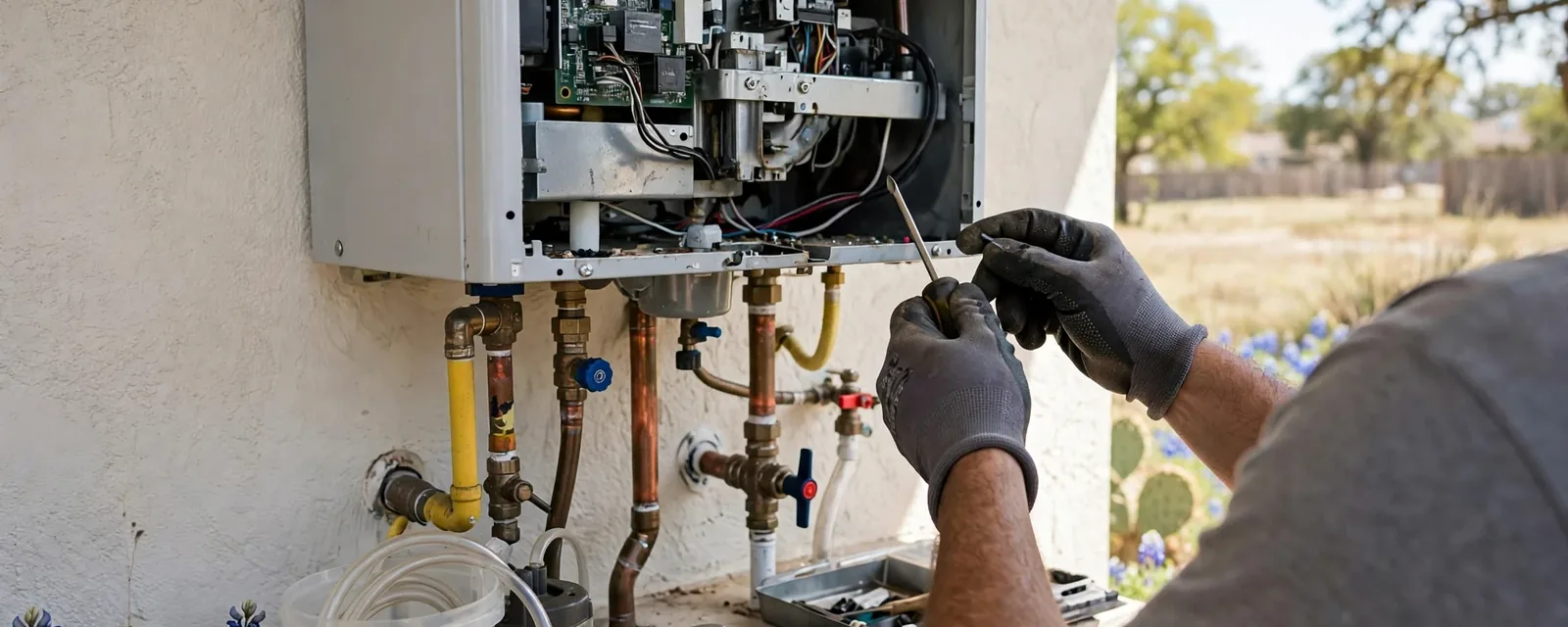
What scale does inside a tankless unit
A tankless water heater heats water as it moves through a small heat exchanger, so even a thin crust of mineral scale matters. In Shafter, CA, as anywhere, scale forms when dissolved minerals drop out of water as it gets hot. The crust narrows the passages and insulates the metal, so the unit works harder for the same result.
You notice it as lukewarm water, a slow climb to temperature, a weaker flow, or an error code on the display. Some units shut down on purpose when they sense poor flow or overheating. That is a protection feature, not proof the heater is dead, and a good flush often brings it back.
This guide covers the standard flush through the isolation valves. It fits most wall mounted gas and electric units. If your manual disagrees with anything here, follow the manual, because service ports, valve styles and cleaning limits differ by brand.
Gather these before you open any valve
A half finished flush leaves the heater with vinegar in it and the water off. Lay everything out first and check that the hose ends fit your service ports.
- Isolation valve kit. Your unit needs service valves on the hot and cold lines with drain ports. If they are missing, a plumber has to add them before you can flush the heat exchanger.
- Small submersible pump. A utility pump of about one sixth horsepower moves the vinegar through the unit at a steady rate. Pumps sold for ponds and sump pits are common choices.
- Two washing machine style hoses. Both need female ends that thread onto the service ports.
- A five gallon bucket. It holds the pump and the vinegar and catches the drain water.
- White vinegar. Plan on two to three gallons of plain, undiluted white vinegar, though your manual sets the amount.
- Basic hand tools. Keep a screwdriver, channel lock pliers, a soft brush, a flashlight and a few towels nearby.
The flush, in order
Set aside about two hours. The pump runs for most of that time, but the setup and rinse take longer than people expect.
- Cut power and gasTurn the unit off at its control panel. Unplug it or switch off its breaker. On a gas model, close the gas shutoff valve. Let the water inside cool for at least half an hour so nobody gets scalded.
- Close the isolation valvesShut the cold and hot valves below the unit. Open one hot tap in the house to relieve pressure in the lines.
- Connect the hosesThread one hose onto the cold service port and the other onto the hot service port. Drop the pump in the bucket, join the cold side hose to the pump outlet, and aim the hot side hose back into the bucket.
- Pour in the vinegarAdd enough vinegar to cover the pump. Open both service port levers so liquid can travel through the heat exchanger.
- Run the pumpSwitch on the pump and circulate for 45 to 60 minutes. Heavy scale may need longer. Cloudy liquid is normal and means scale is dissolving.
- Rinse with clean waterTurn off the pump and empty the vinegar. Remove the cold side hose from the pump and let it drain. Open the cold isolation valve and let fresh water run through the unit and out the hot hose for about five minutes.
- Clean the inlet screenClose the cold valve again. Unscrew the inlet filter screen at the cold connection, rinse it under the tap and brush off grit. A clogged screen alone can mimic scale trouble.
- Restore and testClose the service ports, take off the hoses and open both isolation valves. Open a hot tap until air clears. Restore gas and power, run hot water for several minutes and check every valve for drips.
Stuck halfway through the flush?
Our dispatcher can send a licensed plumber when the unit will not cooperate.
Match the symptom to the likely cause
Not every tankless complaint is scale. This table helps you decide whether a flush is the right first move.
| Symptom | Likely cause | First step |
|---|---|---|
| Lukewarm water at full flow | Scale on the heat exchanger | Descale using the steps above |
| Hot, then cold, then hot again | Short heating pauses at low flow | Open the tap a little wider and read the minimum flow in the manual |
| Weak flow at every hot tap | Clogged inlet screen or a half closed isolation valve | Clean the screen and open both valves fully |
| Error code and shutdown | Flow, overheat or ignition fault | Look up the code in the manual and reset once |
| Water dripping below the unit | Failed valve seal or cracked heat exchanger | Close the isolation valves and call a plumber |
| Smell of gas near the unit | Gas leak | Leave the house and call the gas provider |
If the symptom returns within a few weeks of a clean flush, scale is probably not the whole story. Further testing is a job for a plumber with a combustion analyzer and a flow gauge.
Vinegar, a descaler, or a service call
White vinegar is a mild acid that dissolves calcium carbonate scale, which is the most common deposit. It will not remove every kind of buildup. Some manufacturers name their own descaling solution, and using something else can affect the warranty, so read the manual first.
Keep the room ventilated while the vinegar circulates. Never mix vinegar with bleach or any other cleaner, because the combination can release harmful fumes. Pour used vinegar down a drain with plenty of running water behind it.
Many manufacturers call for periodic flushing, and once a year is a common schedule. Homes with a water softener may go longer between flushes, while homes with a lot of mineral in the supply may need it sooner. Your manual and warranty terms set the real interval.
Hot water, gas and other limits you should respect
Water inside a recently running unit can scald. Gas and electric connections should stay off until every hose is removed and every valve is back in position.
- Never open a gas line, a vent connection or the burner compartment during a flush.
- If you smell gas, leave the area right away. From a safe place, SoCalGas customers can call SoCalGas at 1-800-427-2200. Call 911 if anyone could be in danger or SoCalGas cannot be reached.
- Stop if a valve handle will not turn, because forcing a corroded valve can snap a stem and flood the room.
- Stop if water appears from the heater's cabinet or the vent.
When to put the pump down and call
Call a plumber when the unit has no service valves, when a valve leaks after you close it, or when the display shows the same error after a clean flush. Our tankless water heater service covers valve installation, diagnostics and flushing for homes that would rather not climb a ladder with a bucket.
A heater that has stopped heating altogether is a repair question, not a cleaning question. The plumber who comes out can check igniters, flame sensors, thermistors and gas supply, which is the work behind water heater repair. Sometimes a unit past its working life is better replaced than rebuilt.
Our dispatcher also takes calls from Wasco, roughly 10 miles up State Route 43, and from McFarland, roughly 15 miles away. If you are not sure which problem you have, Call (855) 575-2890 and describe what the display and the water are doing.
What to check about your water in Shafter
The City of Shafter provides water service to residential and commercial customers, and we do not state how hard the local water is. That figure belongs to the utility. Ask City of Shafter Utility Services for its annual water quality report before you decide how often to flush.
You can also test your tap. A hardness test strip kit or a lab test gives a number for your own house. A high reading means scale builds faster, so flush earlier and think about a softener ahead of the heater.
Source type: City of Shafter Utility Services page
Questions about cleaning a tankless heater
How often should I flush a tankless water heater in Shafter, CA?
Follow your manual first. Many manufacturers call for periodic flushing, and once a year is a common starting point. Ask City of Shafter Utility Services for its annual water quality report and test your tap to see how mineral rich your water is. More minerals mean scale builds faster, so you may flush sooner than the manual's baseline.
Can I use vinegar in any tankless unit?
Most units tolerate white vinegar for a short circulation, but some brands specify their own solution. Check the manual and the warranty terms before you start. Never mix vinegar with bleach or other cleaners, and keep the area ventilated while the pump runs.
My heater has no service valves. What now?
A flush needs isolation valves with drain ports on the hot and cold lines. Without them, you cannot circulate vinegar through the heat exchanger safely. A plumber can add the valves, usually as a short job, and then the unit is easy to flush every time.
Is it safe to flush a gas tankless heater myself?
The flush itself works only with water and vinegar, and it is a reasonable DIY job if you shut off the gas and power first. Do not touch gas fittings, the burner or the vent. If you smell gas or see water inside the cabinet, stop and call for help.
What if the error code returns after cleaning?
A repeat code after a clean flush points to another cause, such as a failing sensor, a vent problem or a low gas supply. Write down the code and the symptoms. Our dispatcher can send a licensed plumber to test the unit properly.
If your tankless heater is still not right, Call (855) 575-2890 and our dispatcher will sort out the next step.